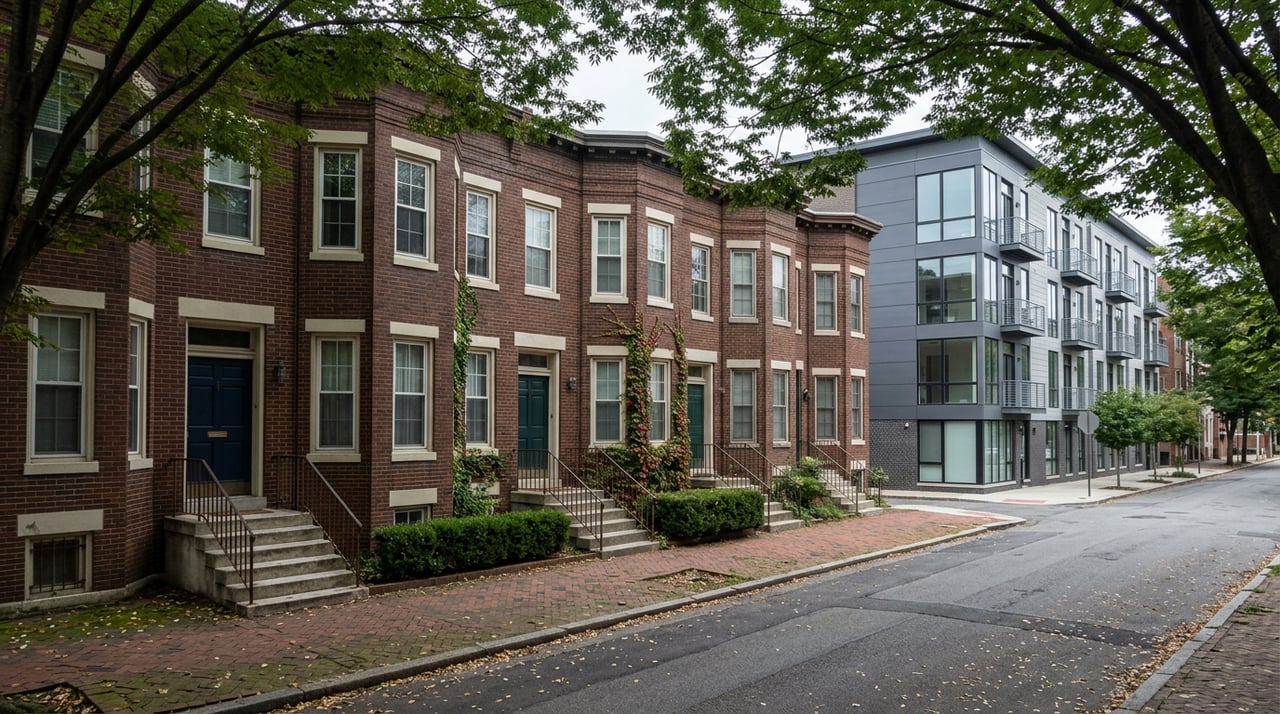
Fluff Festival Turns 21 the Same Week Union Square Finally Gets Its Street Back
September 17, 2026
September 17, 2026
Walk through Union Square on a weekday afternoon this month and you will pass at least one detour sign, hear at least one Eversource contractor's generator, and probably duck around a sidewalk that has been excavated and refilled more times than anyone can count. That has been the texture of the square since work on Somerville Avenue accelerated over a year ago. It is also, for one Saturday, about to disappear entirely under a crowd of people holding fluffernutter sandwiches.
On September 19, from 1 to 5 p.m., Union Square hosts the 21st annual What the Fluff? festival, a tribute to Archibald Query's 1917 invention of Marshmallow Fluff right here in the neighborhood. This year's theme, Legally Fluff: A Toast to Union Square, marks the milestone with live music on the Fluff 'N Jam stage, a returning Fluff Hairdos competition, and an appearance from Arthur Read, the aardvark, according to GBH, which is serving as the festival's public media partner this year. The event is put on by Union Square Main Streets in partnership with the Somerville Arts Council, the same pairing that has run it since 2006.
None of that is the interesting part. The interesting part is what happens to the square in the days on either side of the festival, because three separate timelines that rarely overlap are all converging on the same few weeks.
The City of Somerville's own construction notices put a specific date on the end of a long-running headache: Washington Street is expected to reopen to through traffic at Somerville Avenue on or around Thursday, September 24, five days after the festival wraps. If you have been avoiding that stretch, or rerouting around it out of habit, this is the week the habit breaks.
But read the notice past the first sentence and the picture gets more complicated. Once Washington Street reopens, Somerville Avenue itself reverts to one-way westbound between Prospect Street and Medford Street for roughly two more months, with eastbound traffic diverted via Washington and Medford. In other words, the reopening does not restore the square to normal. It swaps one traffic pattern for a different one that will likely run through Thanksgiving. Anyone driving through Union Square this fall should expect the detour signs to change shape, not vanish.
That distinction matters because it is easy to read "reopening" as "finished." It is not. The city describes this as the completion of major work on the north side of Somerville Avenue, with crews now moving to the south side, from Medford Street to Allen Street, to excavate sidewalks and rebuild drainage and lighting infrastructure through the fall. The square is mid-project, not post-project, even on the week its most visible bottleneck clears.
There is a second, much larger construction story running on a completely different clock, and it is worth separating from the Washington Street work because the two get conflated easily.
Somerville has a 25 percent design plan to rebuild Union Square Plaza and the streets around it, adding more than 1.3 acres of new public open space, which would more than double the 0.56 acres that exist there today. The plan would convert Somerville Avenue to two-way traffic, turn part of Bow Street into a shared space functioning as an extension of the plaza, and add protected bike lanes on Webster Avenue. It is the kind of project that would genuinely change how the square feels to stand in.
It also has no construction date. The city has said it needs roughly $1.4 million to finish design and engineering for the first phase and another $12 million to build it, and as of this year had secured a state grant of just over $700,000 toward that total. City officials have described pursuing additional grants and financing sources while navigating what they call unprecedented pressure on the city's budget. Nothing here is imminent.
So the plaza redesign residents have heard about for years and the detour clearing this month are not the same thing, even though both fall under the umbrella of "construction in Union Square." One has a date. The other does not yet have a budget to finish designing, let alone build.
The same September calendar that carries the festival and the detour reopening also carries something smaller and easier to miss: a handful of eighteenth-century sites in the neighborhood that are usually closed to the public are open on a published schedule this month, part of a series organized by the Somerville Museum and funded in part through the state's MA250 initiative marking the countdown to America's 250th anniversary.
These are not new attractions. They are old ones, unlocked. The published cadence runs select Thursdays from 6 to 8 p.m. and select Saturdays from 10 a.m. to noon, continuing through October. If you have lived in Somerville for years and never been inside these places, this is the stretch of the calendar when that changes, at no cost and with no ticket required.
Put these three threads next to each other and a pattern shows up that a single news item never would. Union Square right now is running on at least three separate clocks. The festival operates on an annual clock, unchanged in format for 21 years and about to hit the same weekend it always hits. The Washington Street detour operates on a construction clock that has a real end date this month, followed immediately by a second, temporary pattern that will run into November. The plaza redesign operates on a civic planning clock that has been moving since 2016 and still has no construction start.
That is worth knowing if you live here, because it means the square you walk through on September 19 is not a preview of the square the city has been drawing up in public meetings for a decade. It is closer to the square as it has looked for the past year: partly rebuilt, partly detoured, and still waiting on the bigger plan. The festival is the one constant in the mix, which is part of why it is worth treating as the anchor point rather than the whole story.
There is a longer arc behind all of this too. Union Square Station Associates, the private developer working alongside the city on the broader 20-acre revitalization, has described the initial phase of that $2 billion project as complete, pointing to the MBTA Green Line station delivered in 2022, a one-time $36 million community benefit, and roughly $4 million a year in new tax revenue. Four years into using that station, according to a March update from the developer's president, the next building on the site, 10 Prospect Street, now has its fifth and sixth floors listing lab space for lease, ranging from about 10,500 to 31,500 square feet. The full build-out the city has described includes 17 building projects and 11 public open spaces, with roughly 60 percent zoned for commercial use and 40 percent for residential. That is the slow, structural version of Union Square's transformation. The festival, the detour, and the unlocked historic sites are the version you can actually see this month.
None of this requires a special trip to notice. Walk to the festival on the 19th, note the detour signs still up around it, and check whether Washington Street looks different by the following week. If you want to see the Powder House or Milk Row Cemetery, this month's Thursday and Saturday windows are the easiest access you are likely to get before next spring. And if a friend asks whether the square's long-promised redesign is finally happening, the honest answer is that a piece of it cleared this month, and the rest is still a design document waiting on a construction budget.
For a closer look at how Union Square's ongoing build-out has shaped the surrounding market, our Somerville neighborhood guide tracks the changes block by block. And if you are weighing what the Green Line Extension has actually done to condo values nearby, we broke that down in a separate look at the numbers.
Whenever the timing is right to talk through what any of this means for your own address, The Residential Group knows this square well enough to help you read it clearly. List with confidence.
Stay up to date on the latest real estate trends.
The Residential Group at William Raveis Real Estate is a team of experienced agents, specializing in the sale of urban dwellings and new construction/renovation properties in Metropolitan Boston. They are consistently ranked among the top sales teams at William Raveis Real Estate and top teams in all of Massachusetts.
27 Boylston Street, Suite #310 Chestnut Hill, MA 02467